✦ A Voyage Through Philosophy
The River of Ideas
An education imagined as a voyage — two and a half millennia of philosophy, traced as a route across parchment.
Open each stop. Read a concise account, watch a curated lecture, complete a short enquiry, and acquire the thinker’s plate. No accounts, no passwords — a private link is your ticket aboard.
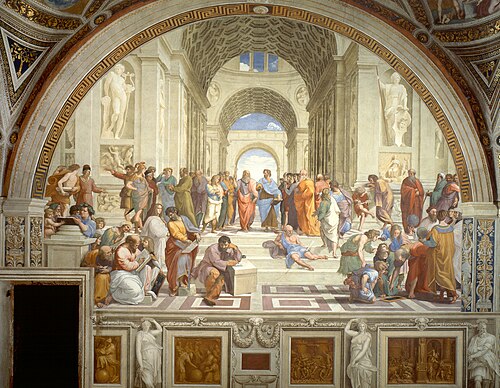 Raphael · The School of Athens (1511)
Frontispiece · The Route, en miniature
See the voyage in motion
✦ A 30-second prospectus
Image-led
Portraits and parchment carry the reading. Each thinker arrives as a plate — bust, painting, or engraving above a literary account.
The Screening Room
Curated lectures from TED-Ed, Crash Course, The School of Life, and Wireless Philosophy — never an open search. Held within; nothing plays until you choose.
A private link
Your progress lives under a private link — bookmark it, scan a QR on a second device, or hand it to a friend. No accounts, no passwords, no advertising.
The regions you’ll cross
Five ages, and an Eastern expedition

600 BC – 200 AD
Ancient Greece
J.-L. David · The Death of Socrates (1787)

400 – 1400
The Middle Ages
Très Riches Heures · 'Anatomical Man' (15th c.)

1400 – 1700
Early Modern
Vermeer · The Astronomer (1668)

1700 – 1900
Enlightenment & 1800s
Wright of Derby · Air Pump (1768)

1900 – now
Modern Times
Van Gogh · The Starry Night (1889)

a side-expedition
Eastern Philosophy
Wang Ximeng · Rivers and Mountains (1113)
Before you set sail
Common questions
- Is The River of Ideas free?
- Yes — completely free. There is no account to create, nothing to pay, and no advertising.
- Do I need to sign up or log in?
- No. Your progress lives under a private link you can bookmark or share — there are no passwords, and we collect no personal information.
- Who is it for?
- Curious adults and older students — anyone who wants a guided, plain-language tour through 2,500 years of philosophy without wading through a textbook.
- How long does it take?
- Go at your own pace. Each thinker is a short stop — a few minutes to read and watch a curated lecture — and the whole voyage is thirty stops across five ages.
- Is the content accurate?
- Every account is written from established sources, and each thinker links out to Wikipedia and the Stanford Encyclopedia of Philosophy so you can read further.